
Hayward Previous Residents Across Eras
A backward Hayward address search needs an era plan. Alameda County’s recorded documents begin with the county’s 1853 creation, but the electronic name index begins in 1969. Hayward’s historical directory and map sources overlap only in selected years. The table separates ownership, occupancy, physical change, and municipal work so that a Hayward finding is not stretched beyond what the record can show.
| Source | Years It Covers | Where Held | What It Shows |
|---|---|---|---|
| Hayward deeds in Alameda recorded documents | 1853-present; electronic 1969-present | Clerk-Recorder, Oakland; Hayward online and microfilm | Grantors, grantees, instruments, dates, legal descriptions |
| Hayward Polk directories | Cited 1925-1976 | HAHS, Oakland Public Library, area libraries | Hayward names and addresses, with edition and abbreviation limits |
| Hayward Sanborn map sequence | 1923, updated through 1960 | HAHS citation and map research collections | Hayward footprint, use, block and physical continuity |
| Hayward federal census schedules | 1930, 1940, 1950 available in 2026 | NARA and library genealogy access | Household relationships, occupation, age, and enumeration district |
| Hayward permits and property files | Online mainly 2014-present; earlier by request | Hayward Development Services | Applicants, contractors, scope, inspections, and available plans |
| Hayward HAHS accounts and assessments | 1876-1949 | Hayward Area Historical Society | Unusual taxpayer, account, and local property trails |
Start with the deed chain when the question is ownership. Start with a Hayward directory or census when the question is who occupied the address. For previous residents, the best source may be a dated directory rather than the newest parcel record. Use Hayward maps and permits to test whether a building or parcel changed. The record with the closest date is not always the record with the closest answer.
The Alameda recorded-document copy order form is tied to an identified Hayward instrument. It is not a free name index and cannot replace the historical index work needed for older years.
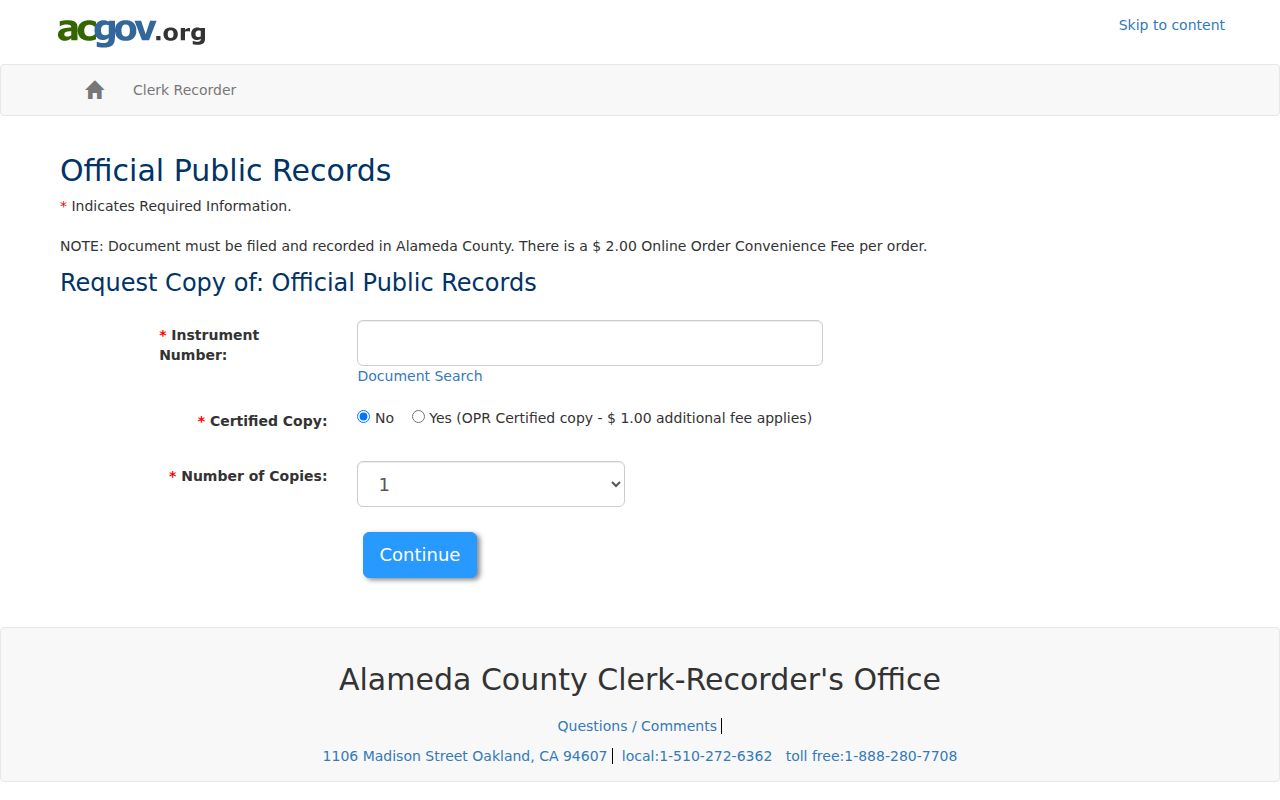
The Hayward recorded-document image belongs at the start of an address history because a deed can anchor a name and date before other sources are paired.
Hayward Deed Records and Past Owners
Use the APN as the bridge between a Hayward street address and the recorded title trail. The Hayward city WebMap can provide a parcel, situs address, APN, a censored public owner lead, and a separate tax mailing address. Alameda’s Assessor searches by APN or site address and does not provide a confirmed public owner-name search online. Confirming a Hayward owner may require the Assessor lobby kiosk, phone, or email channel before the Recorder index is searched.
- Search the Hayward address in Hayward WebMap, record the APN, legal description, situs, and mailing-versus-situs distinction.
- Use the current Hayward owner lead to search Alameda’s electronic recorded-document index as a grantee and match the likely acquisition by date, APN, or legal description.
- Read the Hayward instrument for the seller, who is the grantor on that transfer, then search that seller as an earlier grantee.
- Repeat the Hayward grantee-to-grantor loop and preserve the instrument number, recording date, document type, and book, page, reel, or image reference.
- When the trail reaches 1968, move from the electronic index to the alphabetical microfilm and counter process at the Oakland Recorder office for Hayward research.
- Grantor and grantee
- A Hayward deed’s grantor transfers an interest. The grantee receives it. One deed can put the same person in different roles than a later deed.
- Chain of title
- A chronological sequence of Hayward recorded transfers that connects one ownership interest to an earlier one.
- Legal description
- The Hayward parcel’s formal land description. It can remain useful when an old street name or number no longer matches the modern address.
A Hayward index hit proves that a document was recorded. It does not prove current residence, full ownership, or an unencumbered title. Deeds, releases, liens, plats, and other instruments answer different questions.
Hayward Previous Residents at the 1969 Deed Index Boundary
Alameda County’s most important Hayward time boundary is 1969. The electronic name index covers 1969 to the present, while the complete recorded-document series reaches back to 1853. For 1853 through 1968, grantor and grantee indexes are on microfilm and must be searched in person. The older method is slower, but the boundary changes technology rather than the survival date of the county’s record series.
The Recorder office for Hayward research is at 1106 Madison Street in Oakland, with a Dublin satellite at 7600 Dublin Boulevard, Suite 160. A document recorded in the last three months may need a Customer Service instrument-number request when the document type and party names are supplied. A new filing can take about two weeks to become orderable. Those timing details matter when a recent Hayward acquisition seems absent from an online copy order.
Hayward’s 1868 magnitude-7 earthquake damaged nearly every local building, but no authoritative source established a corresponding loss of Alameda record books. Do not turn a damaged Hayward building into an invented records gap. Preserve a negative search note, then test the microfilm, deed books, plat, APN, and legal description.
The California State Library history collections provide a useful parallel Hayward path for maps, newspapers, and local history when a deed index stops at a name or parcel.

The California history collection image signals the kind of Hayward archival bridge needed once a modern electronic title search reaches an older date.
Hayward Past Residents in Permit Records Before 2014
Hayward permits add a property timeline, not a substitute owner list. Hayward’s public e-Permits search holds current records primarily from 2014 forward and can show address-linked cases, applicants, contractors, scope, status, inspections, and related work. An applicant may be a contractor or designer rather than a resident or titled owner, so the name must be labeled by role.
Earlier Hayward permits and property files require a narrow California Public Records Act request through the city. The city’s property-record guide says older material may need a request or archive search, and stamped architectural or engineering plans require designer permission through an affidavit. Plan copies can take up to 30 days. A concise request should identify the address, APN if known, date range, permit type, and the existing record sought.
Compare a Hayward permit date with the deed chain and the 1954 or current aerial. A permit may document work on a structure while the deed documents a transfer of land. Neither alone establishes who occupied the address during the work.
Hayward Past Residents in Polk and Sanborn Records
The cited Hayward Polk run spans 1925 through 1976, but that bibliography range does not prove that every annual volume survives. Oakland Public Library gives a more exact shelf fallback: combined Hayward and San Leandro volumes for 1948 and 1951, then Hayward editions for 1956/57, 1959, 1962, 1965, 1967, 1969, 1971, and 1976. The Hayward telephone directory for September 1952 through September 1953 is digitized by the Library of Congress and shows subscriber or business name, street address, and telephone number.
Sanborn fire-insurance maps follow a different evidence path. The cited Hayward sequence begins in 1923 and is updated through 1960. It can show a building footprint, use, block number, and physical change, but it does not reliably name the people who lived there. The Hayward city WebMap also offers a 1954 aerial basemap. That is an insider’s bridge between mid-century development and current parcel geometry, not an identity record.
Use the Hayward map and directory together. A house that appears in a 1954 aerial but lacks a directory entry may still have had occupants. A directory address with no matching current footprint may reflect demolition, subdivision, an old number, or a search error. Record the edition, sheet, address spelling, and map date every time.
The Library of Congress Sanborn searching guide explains city, edition, and sheet selection before a historical map is interpreted.
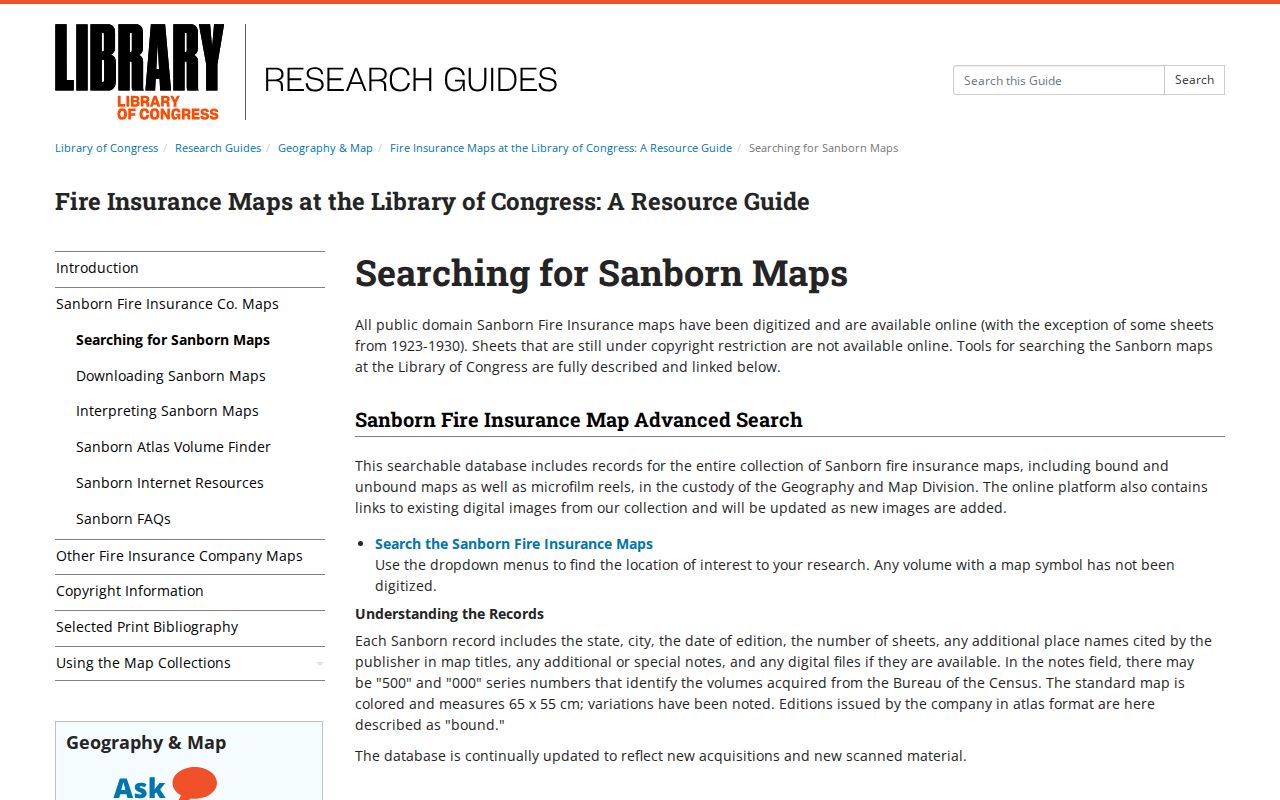
The Hayward Sanborn image belongs beside the address trail because map sheets test the physical continuity of a parcel without overstating what a map can identify.
Hayward Households in Directory Years
Ownership and occupancy are different Hayward trails. Hayward and San Leandro directories can show an address entry, while census schedules can show household relationships, age, occupation, and enumeration district. A directory may include a head of household, an abbreviated name, a business listing, or a missed entry. The collections themselves are described in the Hayward city directory collections reference, while the backward address method keeps the question tied to one Hayward parcel.
- Choose a Hayward directory edition near the target year and transcribe the address exactly, including abbreviations and unit marks.
- Compare the same Hayward address in the nearest available edition before and after it, without assuming that a missing name means a move.
- Pair the directory result with the 1930, 1940, or 1950 census when the address and enumeration district can be matched.
- Check Hayward newspapers, permits, deeds, and local collections for the years between census schedules.
- Save the edition, page, source holder, and any uncertainty so another Hayward searcher can reproduce the trail.
Federal census schedules become public after 72 years, making 1950 the newest public census year in 2026 and 1960 unavailable until 2032. The interval between 1950 and later Hayward directories is therefore filled by local newspapers, telephone books, permits, and recorded documents rather than a later federal schedule.
Hayward Past Residents in Obituaries and Probate
Obituaries and probate can close a Hayward past-resident trail, but they should be used as corroboration. Hayward Public Library databases include Heritage Hub obituaries and death notices, the Daily Review from 2001 forward, East Bay Times from 2016 forward, and older newspaper resources with card or login limits. HAHS holds substantial clipping runs, yet it specifically does not hold birth, marriage, or death certificates.
Alameda County vital records use authorized and informational copy rules rather than a simple age-based opening. Informational birth, death, and public-marriage copies can be ordered by other requesters, while unrestricted identity-valid copies require an eligible relationship, role, or court order. Confidential marriages remain restricted to the parties or a court order. A Hayward death record can confirm an event, but it does not by itself prove that the person lived at the target address.
For Hayward probate, use the Alameda Superior Court case index and request process. A case result may show parties, filing dates, register events, hearing information, and eligible public images, while sealed, juvenile, adoption, confidential family, and other protected material is withheld. Match the decedent, parcel, dates, and named executor or heir to the deed and directory trail instead of treating a shared surname as proof.
The Alameda vital-record ordering page explains the county’s Hayward application route and the distinction between a certificate order and a free name index.
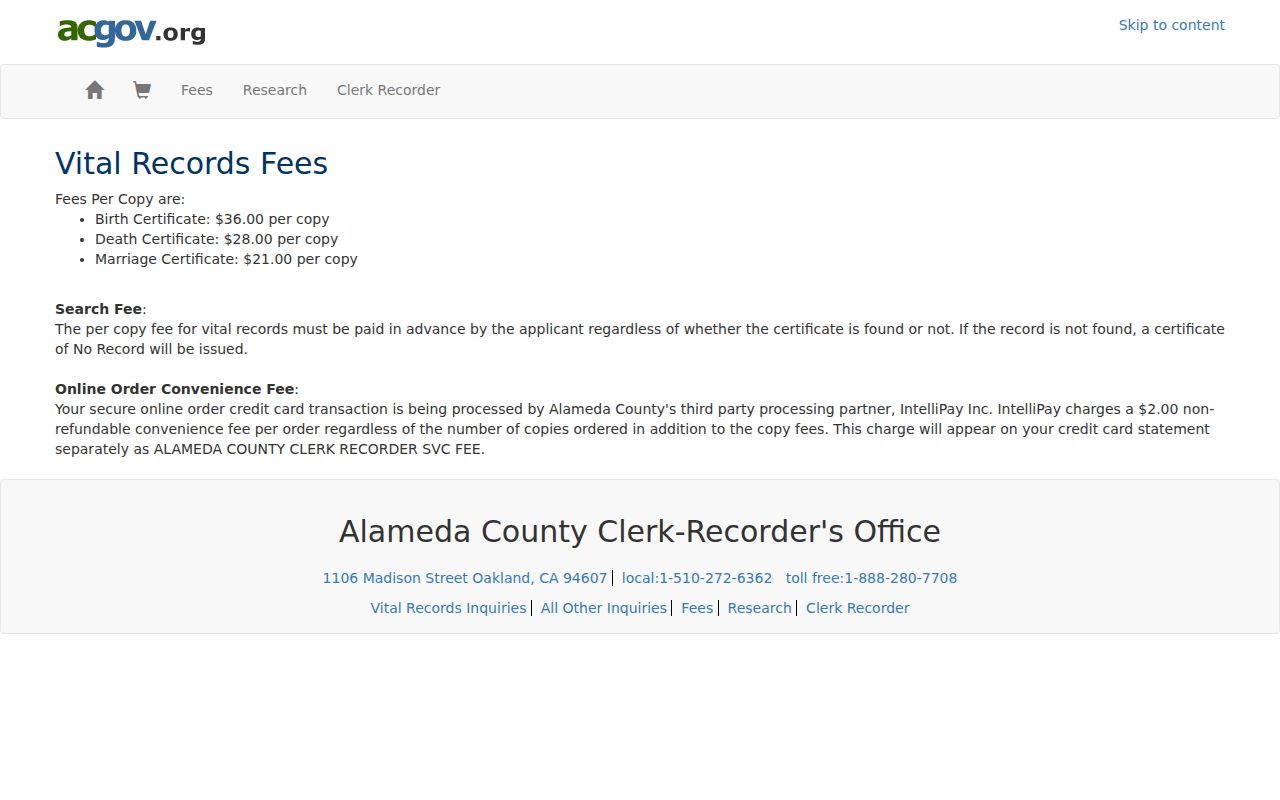
The Hayward vital-record image marks an endpoint that needs eligibility and identity rules, not a shortcut around the parcel and household evidence.
Hayward Previous Residents in HAHS Ledgers
The Hayward Area Historical Society holds an unusual set of sources for previous residents. Hayward City account ledgers and assessments run from 1876 through 1949. Other holdings include Hayward and Alameda County school directories from 1916 through 1963, Poultry Producers records from the 1920s and 1940s, newspaper clippings, cemetery material, and more than 20,000 photographs. These collections can identify taxpayers, students, local officers, and community groups that ordinary Hayward property records do not show.
HAHS is at 22380 Foothill Boulevard, second floor, Hayward. The phone is (510) 581-0223 and the research email is archives@haywardareahistory.org. Appointments are strongly advised. Hayward on-site research and quick archivist responses are free; remote written requests normally take two to three weeks, and image reproduction or publication can carry a charge. The partial online catalog helps identify a possible collection before a request is written.
A focused remote request should include the Hayward address, known names, APN or legal description, date range, and the exact ledger, directory, clipping, or photograph question. These previous residents sources work best when each Hayward item is labeled by date and keeper. HAHS can point to its holdings, but it is not the custodian for every record type. A request for a certificate, court file, or county deed belongs with the agency that holds that series.
The Hayward Area Historical Society collection gateway is the starting point for appointments, research services, and local holdings.

The HAHS Hayward image reflects the local archive layer, where ledgers and clippings can connect a parcel history to a named household or community role.
Hayward Address Records Across Time
No authoritative Hayward citywide renumbering year was located. When an older address stops matching, bridge it with the APN, legal description, subdivision plat, map sheet, directory address section, retired-address status, and aerial evidence. Search both the modern street form and the historical spelling. A Hayward parcel identifier is often more stable than a number printed in a newspaper.
Russell City creates a separate Hayward indexing problem. A 2023 Hayward research presentation reported that FamilySearch lacked a unique Russell City place identifier and that broad Hayward vital searches produced huge result sets. Older records may use Alameda County, Eden Township, Russell City, or another nearby place label. Test those names before concluding that a Hayward family or address is absent.
For a Hayward discontinuity, write down what changed and what did not. The same APN with a new street number suggests an address change. A new APN may indicate a subdivision or parcel split. A directory disappearance without deed, obituary, or permit support remains unresolved.
Lawful house history. Previous-resident research in Hayward belongs to family history, property history, genealogy, and personal curiosity. Do not use a name or address trail to stalk, harass, threaten, or track a living person.