
Finding People in the Hayward Residents Directory
Hayward has no single current residents directory that names every household. The useful route depends on the fact sought. A parcel record can tie an owner lead to a situs address. A recorded deed can show who transferred or received an interest. A court index can show a party and case event. A business filing or professional license can confirm an official role. A library volume can place a household at an older address. These sources overlap, but they do not answer the same question.
The strongest Hayward search begins with one stable clue, then adds an independently created record. Start with an address when the property is known. Start with a name when a case, license, deed, or entity role is known. For family history, keep the spelling, middle initial, former surname, and time period intact. Public sources may omit household members, protected people, and anyone who never appeared in the record series, so a result is a lead rather than proof of present residence.
- Confirm the jurisdiction and parcel in the Hayward WebMap, noting the APN, situs address, and mailing fields.
- Use the Alameda property portal or the Assessor's controlled channels for ownership details the public web search does not display.
- Search the Alameda recorded-document index for the current Hayward owner, then use the grantor and grantee names to follow earlier transfers.
- Check the relevant Hayward court, California business, license, vital, or voter-status source based on the question.
- Use Hayward library and historical-society collections, or make a focused CPRA request, when the needed record is offline.
Hayward Resident Records Offices
Hayward is an incorporated city inside Alameda County, so the resident-record trail crosses city, county, and state custodians. Hayward City Hall handles municipal legislation, permits, code, police, and administrative requests. The County Clerk-Recorder handles deeds, fictitious business names, and vital certificates. The Assessor and Treasurer connect parcels to assessment and tax systems. The Alameda Registrar controls voter-file access, while the Superior Court holds case records. Each office can confirm a different kind of public fact.
Alameda Clerk-Recorder for Hayward
1106 Madison Street
Oakland, CA 94607, serving Hayward
(510) 272-6362
Alameda County Assessor for Hayward
1221 Oak Street, Room 145
Oakland, CA 94612, serving Hayward
(510) 272-3787
Alameda County Registrar for Hayward
1225 Fallon Street, Room G-1
Oakland, CA 94612, serving Hayward voters
(510) 272-6933
The office map matters because a Hayward mailing line may sit in unincorporated Alameda County, while a Hayward deed or vital record belongs to the county regardless of city boundary. Use the Hayward city map to confirm jurisdiction before asking a department to search its files.
Hayward Resident Name-to-Address Trail
A name becomes useful when it can be anchored to a stable identifier. The Alameda recorded-document system is party-name based, while the parcel and permit systems are address based. A practical bridge is the APN or legal description. Search the Hayward map for the situs, record the APN, then compare the public owner lead and tax mailing address. Search the deed index under the recorded party, not under a guessed occupant. The county's electronic index begins in 1969, and older party-name work moves to microfilm and the counter.
The Alameda recorded-document portal can identify a Hayward document by grantor, grantee, instrument number, type, and recording date. A hit proves that an instrument was recorded. It does not by itself prove current residence, unencumbered title, or the identity of every person connected to an address. Match the deed to APN, legal description, and chronology before treating the name as the right person.
The vocabulary is plain once the Hayward record roles are separated.
- Roll
- An official Hayward list or account, such as an assessment roll, created for a defined administrative purpose.
- Index
- A Hayward finding aid that points to a record; it may show a party and date without exposing the full image.
- Parcel
- A mapped Hayward piece of land identified by an APN, with situs and tax-mailing fields that may differ.
- Criss-cross directory
- A street-order directory that can turn a Hayward address into an older name lead, subject to the volume's coverage and gaps.
Note: A stable number narrows a Hayward same-name search, but the custodian still decides what the record proves.
The Alameda deed index screenshot below comes from the County's official recorded-document entry point. It is useful as a visual cue for the Hayward starting gate, while the actual search must follow the county's live rules.
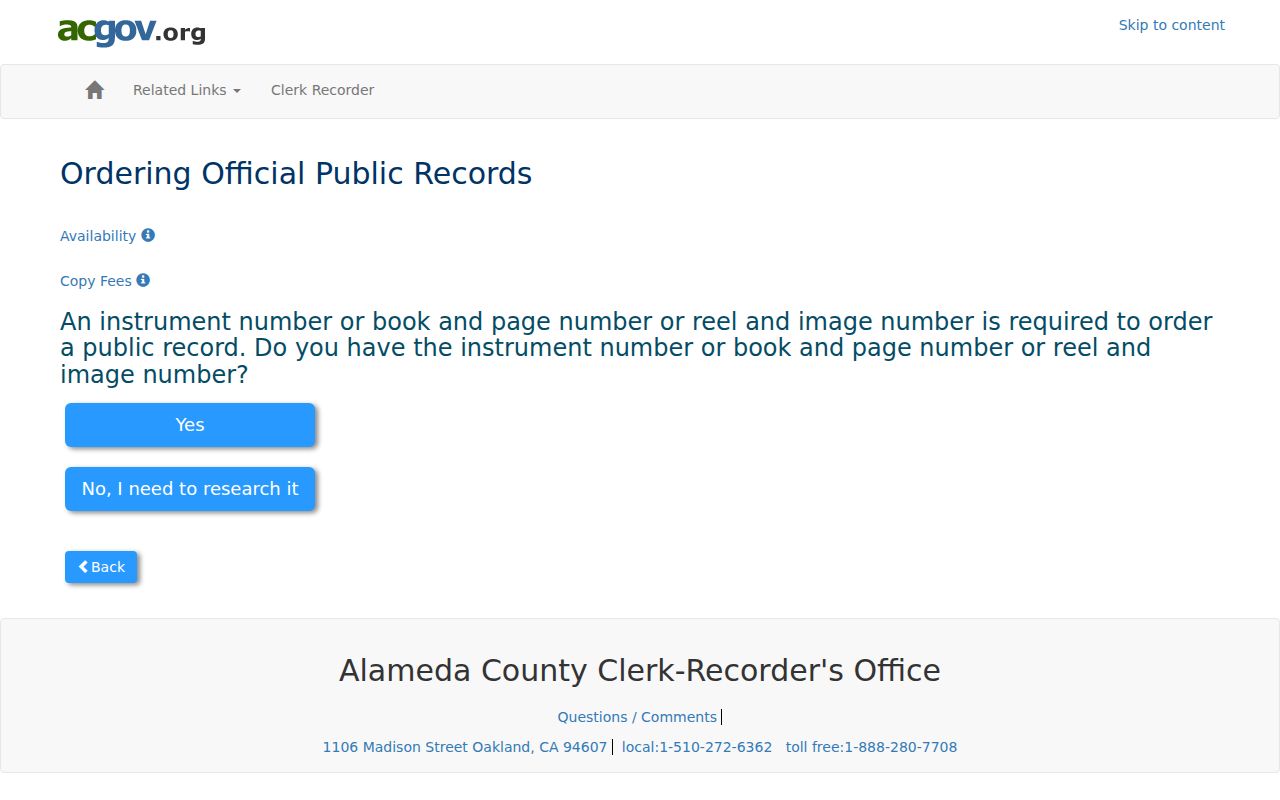
The Hayward index is the first link in a chain, not a finished resident list. For a current person-focused task, a case number, license number, entity number, or APN is safer than a name alone.
Current Hayward Resident Directories
Current Hayward resident directories are really several partial sources. Property and tax systems favor owners and parcels. Court and business systems favor parties and official roles. A city permit file favors applicants, contractors, project sites, and inspections. A voter status tool is an authenticated self-check, not a public street list. The table keeps those scopes separate so a search does not turn one record into a claim it cannot support.
| Source | Who It Lists | Keeper | Access |
|---|---|---|---|
| Hayward parcel and assessment | Parcel, owner lead, situs, tax mailing, value and characteristics | Alameda Assessor / Hayward GIS | Address or APN; owner web mode not confirmed |
| Hayward recorded documents | Grantors, grantees, liens, deeds and other instrument parties | Alameda Clerk-Recorder | Electronic index from 1969; older microfilm |
| Hayward city permits and files | Applicants, contractors, owners when recorded, scope and inspections | Hayward | e-Permits mainly 2014 forward; older CPRA request |
| Hayward voter status and file | One voter's status, or permitted file fields for qualified users | California and Alameda elections offices | Self-service or purpose-restricted application |
| Hayward business and license records | Entity roles, agents, registrants, licensees and public business addresses | California SOS, DCA, and Alameda Clerk | Basic searches are free; fields vary |
Use the Hayward source that matches the question, then corroborate with another keeper. The Hayward resident lookup workflow is the better fit when one person's name is the starting point, because it separates an owner, a court party, a licensee, and an entity role.
Use the Hayward Parcel Map for Resident Leads
The Hayward WebMap is the cleanest first move for a Hayward address search. Its locator can find an address, its parcel layer can show a public or censored owner field, and its popup separates the situs from the tax mailing address. APN variants, parcel area, tax-rate area, and complete situs parts help bridge the map to County assessment and recorded documents. The map also layers zoning, hazards, schools, planning neighborhoods, historic resources, inspection districts, police beats, and fire districts.
| Hayward address and streets | Geocoder and autocomplete for the Hayward city locator. |
|---|---|
| Hayward layer list | Hayward parcels, zoning, hazards, districts, neighborhoods, schools, and related Hayward map layers. |
| Hayward basemap | Parcel, topographic, elevation, and Hayward 1954, 2014, 2017, 2020, and 2023 aerial choices. |
| Hayward parcel identify | Map click for Hayward APN, situs, mailing, and available Hayward owner fields. |
| Hayward print and export | Hayward print, PDF, Word, Excel, and Hayward KML-type configuration controls. |
The Hayward WebMap launch page frames the same Hayward address geography used by Hayward city staff. The map is not a legal survey, and a shared mailing line does not prove that all people at a parcel share one household.
The county's Alameda Parcel Viewer page supplies a second Hayward parcel route. Compare the two when a postal Hayward address may sit in Ashland, Cherryland, Fairview, or another adjacent jurisdiction.
Once the Hayward parcel is confirmed, move to the custodian that owns the next record. Do not ask the city to answer a County title question or the voter portal to act as a public address list.
Why 1969 Splits Hayward Resident Searches
Alameda County's recorded-title series reaches back to the county's 1853 creation. The important break is access technology, not the survival of the earlier deeds. The electronic computer index covers 1969 to the present. Party-name indexes from 1853 through 1968 are on microfilm and require in-person research at the Clerk-Recorder. A search that stops at the online cutoff can miss the very deed that explains a Hayward address and parcel.
The Hayward counter route is more exact when the document is recent or the online path fails. The County says a filing may take about two weeks to become orderable, and Customer Service may provide an instrument number for a document recorded within the last three months when the requester supplies the document type and party names. Copies are paid, and older work may need a book, page, reel, or image reference.
The Hayward recorded-document research page is the source for this cutoff and the access route. It is also where a searcher should learn whether an index hit is enough or whether a paper or certified copy is needed.
Note: The Hayward 1969 boundary marks the index you can use online, not the first year an Alameda deed exists.
That distinction is a useful local story. Hayward incorporated in 1876, and the city’s account ledgers and assessments begin in the same year, but title research can reach further back through the County. A Hayward family trail can therefore start in a city ledger, cross a directory, and then move into a county deed book without treating the modern web as the whole archive.
The Hayward electronic index is a captured example of the modern records landscape, not a substitute for checking the current County interface or the microfilm room when the dates fall before 1969.
Hayward Court, License, and Business Records
A current Hayward name trail often improves when the property record is not the right fit. Alameda eCourt covers civil, appeals, small claims, family, probate, mental health, and adoption matters with access controls. Odyssey supplies criminal case information for cases active since 2005, while public web results do not include criminal document images. California bizfile identifies an entity, its status, filing history, agent, and filed roles. DCA's license search can filter by board, license type, name, license number, city, county, and ZIP.
These Hayward records describe a case party or official business role. A registered agent is not necessarily an owner, and an entity address is not automatically a private home address. Use the record to decide which custodian to ask next, then check the case number, entity number, or license number rather than blending names from different systems.
The Hayward court portal image below comes from the Alameda Superior Court records information page. It represents the Hayward court route, where a result may expose party names, case numbers, filing dates, hearings, and eligible images.
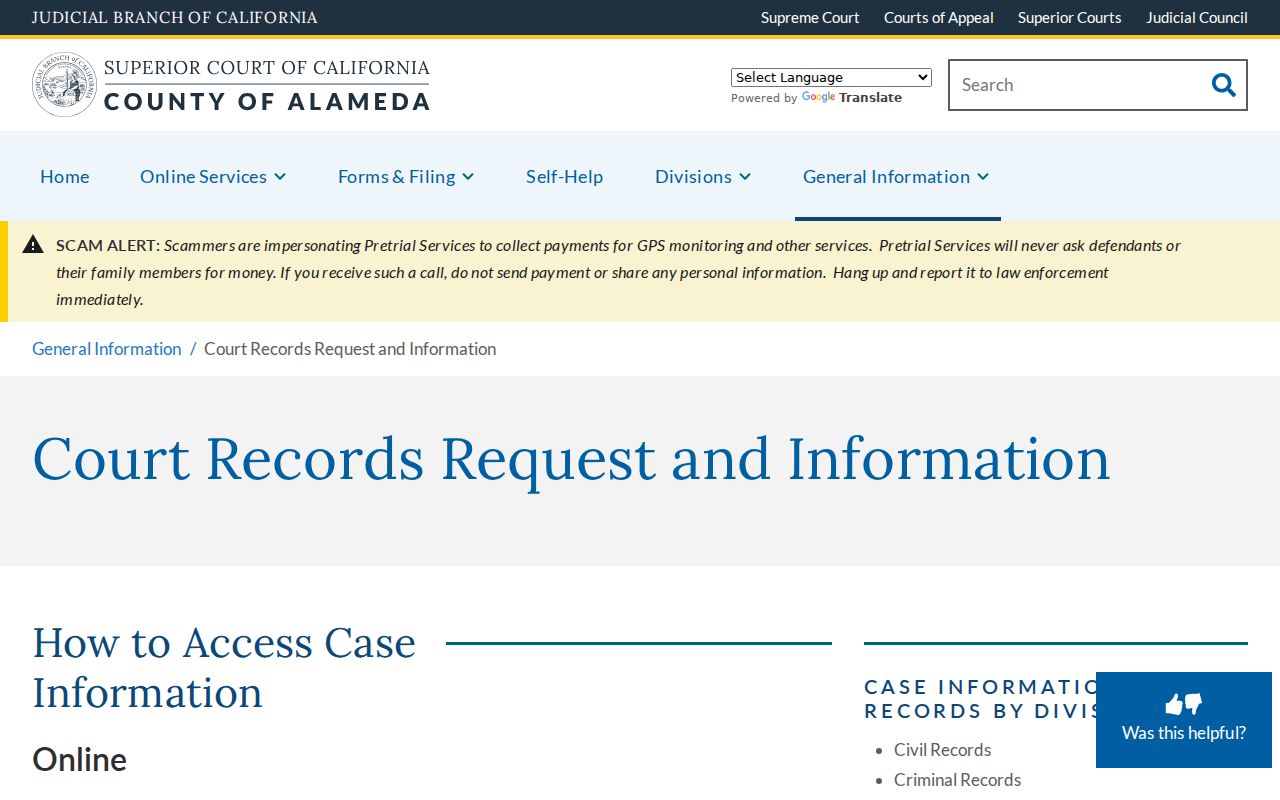
Hayward family documents, sealed matters, juvenile files, adoption details, and many mental-health records remain controlled. The courthouse kiosk can sometimes show public criminal documents that the web view does not.
The Hayward business search screenshot below is linked to bizfile Online, the Secretary of State's official entity search.
A Hayward business filing can help reconnect a person with an organization or check a seller's stated entity role. It should not be recast as proof of where every household member lives.
The second role-based Hayward route is the California Department of Consumer Affairs license search, which exposes board, license type, name, number, city, state, ZIP, and county filters.
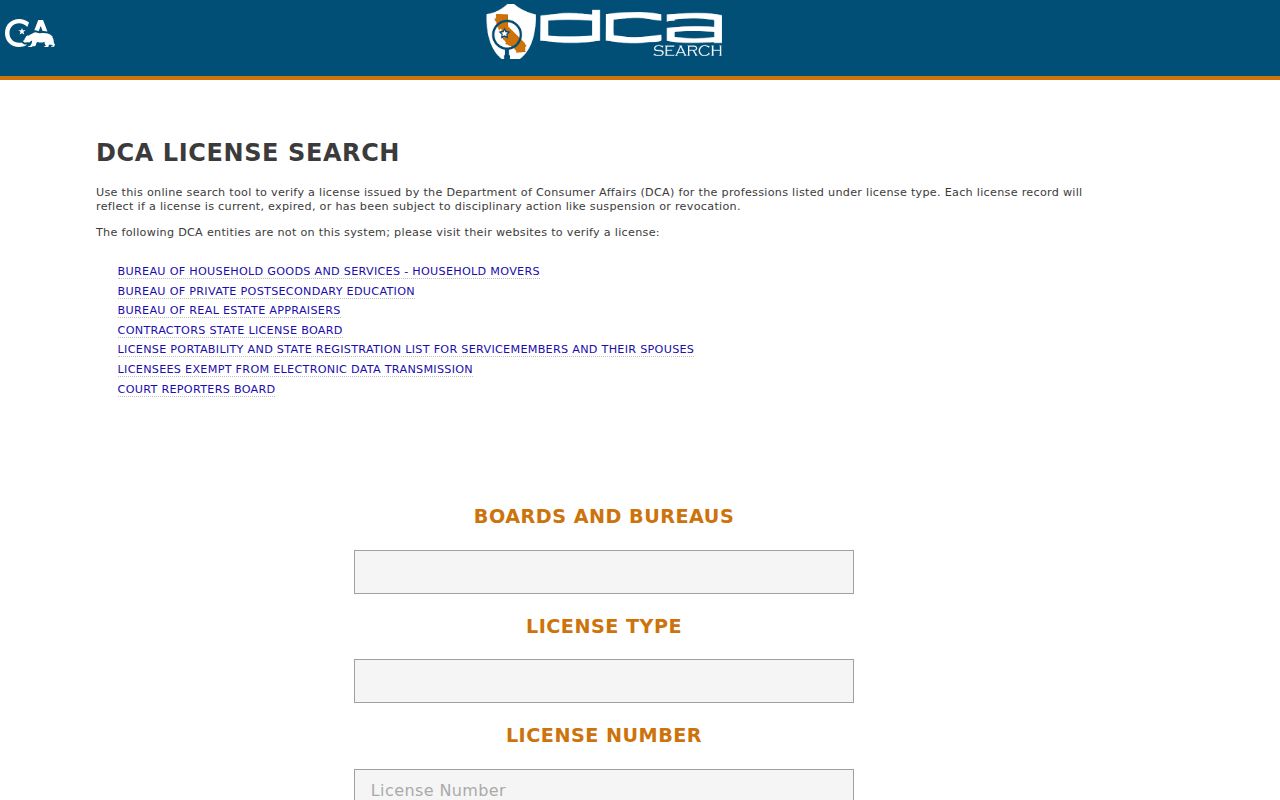
Hayward license results can show status, issue or expiry information, an address of record, and discipline links, with public fields varying by board. Treat the licensee's role and address of record as distinct facts.
Hayward Resident Addresses in California Voter Data
California's voter route is easy to misunderstand. The Secretary of State status page sends a voter to county tools such as Alameda My Voter Profile. The self-check uses identity and contact fields, including a California driver license or ID, the last four digits of a Social Security number, and date of birth. Those authentication values are not public. The result is for the person checking registration, not a public Hayward street search.
Elections Code §2194 limits Hayward voter-information release to election, scholarly, journalistic, political, and governmental purposes. Government Code §7924.000 keeps home addresses and identifiers confidential outside the allowed channels. A qualified file request asks for the applicant, organization, geography, purpose, security, and signature. Safe at Home participants use a protected route rather than ordinary online registration, and protected addresses remain suppressed.
The voter-status screenshot below leads to the California Secretary of State registration gateway. It is a personal verification route, not a Hayward residents directory.
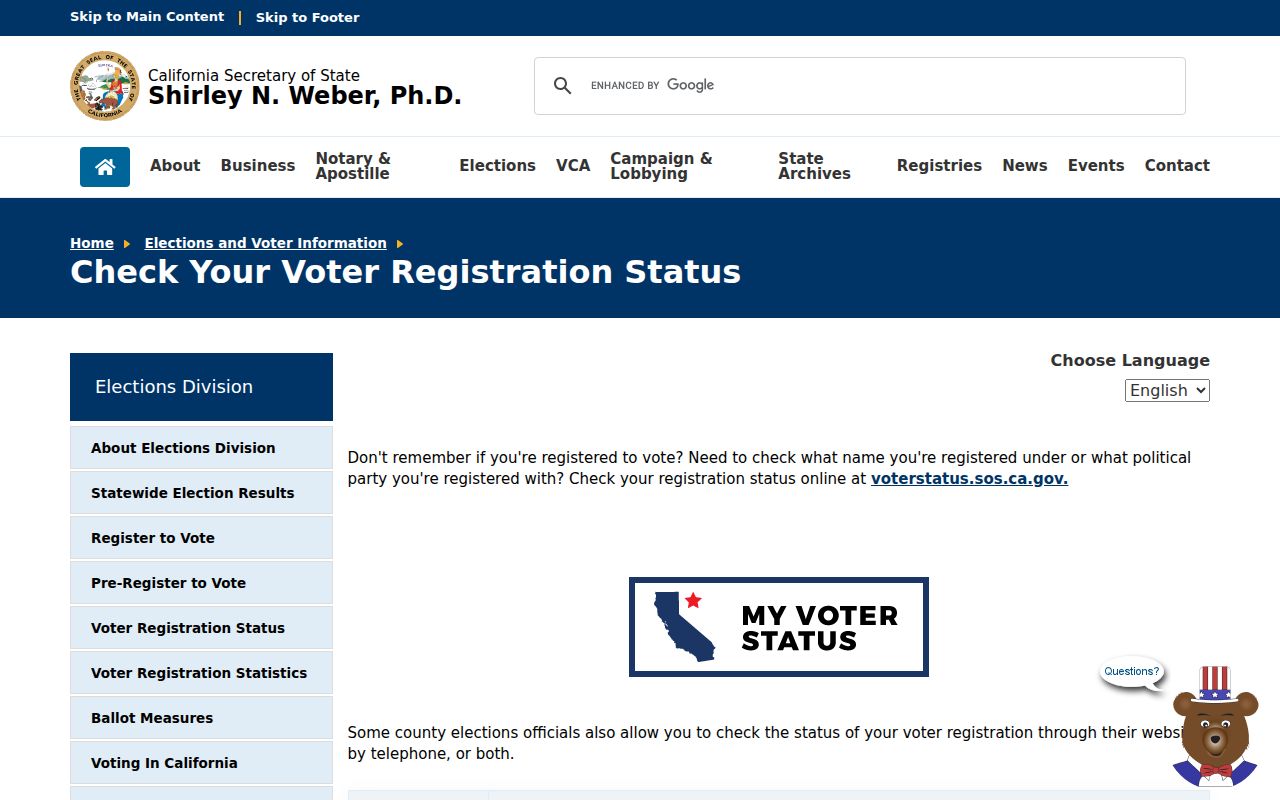
Note: A voter status result can confirm registration administration, but it cannot supply a public block roster or ballot choices.
For lawful Hayward family or civic research, keep voter evidence in its narrow lane and use parcel, deed, court, business, or historical records for the other parts of the question.
Historical Hayward Resident Directories
Hayward's historical directory trail is stronger than a single shelf label suggests. The cited Polk span is 1925-1976, but the research cautions that a bibliography span does not prove that every annual volume survives. Exact fallback volumes include Polk's Hayward and San Leandro in 1948 and 1951, plus Hayward editions for 1956/57, 1959, 1962, 1965, 1967, 1969, 1971, and 1976 at Oakland Public Library. San Leandro's History Room adds a 1925-1965 run, yearbooks from 1933 forward, maps, clippings, obituary work, and Alameda census data.
The Hayward Area Historical Society holds Hayward city directories and telephone books with some years not itemized online. Its archive at 22380 Foothill Boulevard is appointment based, with free on-site work and quick answers, while remote written requests generally take two to three weeks. The Hayward Public Library offers local newspapers and Heritage Hub obituary and death notices, subject to card or in-library limits. A Hayward directory entry can place a name at an address, show a telephone line, or provide an occupation clue, but a missing entry does not prove a move or death.
The full Hayward collections trail, including the 1952-53 Library of Congress telephone volume and the directory abbreviation method, belongs on the Hayward city directory collections page.
Hayward's Postwar Directory Boom
Hayward's numbers explain why mid-century records can be so rich and so hard to read. The city's population grew from about 14,000 in 1950 to 72,000 in 1960, a fivefold rise tied to the shift from orchards and ranches to subdivisions. Most neighborhoods and districts were built from the 1950s through the 1970s. That growth left overlapping evidence in telephone books, Polk volumes, subdivision plats, permits, aerials, and assessor files.
For a 1950s Hayward address, compare the directory with the 1950 federal census, then use the 1954 aerial in the Hayward WebMap to see whether the structure and street pattern fit. For a later Hayward address, add the permit portal and the 1960 census when it becomes public in 2032. A directory helps with names and occupations; a deed shows a title event; an aerial shows physical change. Each layer answers a different part of the history.
Hayward's agricultural past also matters for place names. Older records may use Rancho San Lorenzo, Eden Township, Russell City, or an adjacent community rather than modern Hayward. Search those labels when a broad Hayward query produces a misleading flood of results.
Hayward Resident Library and Archive Fallback
Digital search ends sooner than the Hayward record story. Hayward Public Library's online resources include Hayward Daily Review full text from 2001 forward, East Bay Times from 2016 forward, San Francisco Chronicle from 1985 forward, Heritage Hub, NewspaperArchive, and Gale Primary Sources. Earlier context comes from Hayward Journal issues, Oakland Tribune and Daily Review clippings, the Haypress school paper, and the Hayward Area Historical Society's research files. Database access can require a library card or in-library use.
HAHS adds City account ledgers and assessments from 1876-1949, Alameda County School Directories from 1916-1963, Hayward Poultry Producers records from the 1920s-40s, cemetery material, Farm Bureau reports, and more than 20,000 photographs. These are unconventional trails for taxpayers, students, officers, and local groups. They do not form a public current residents directory, but they can explain a name that never appears in a modern parcel record.
Note: Ask a Hayward librarian or archivist to verify the exact volume before calling a cited date range complete.
A focused Hayward request should name the person, address, record series, and date range. That gives staff a search they can perform without guessing which collection the question belongs to.
Hayward Records Requests by Subject
When a city record is not online, Hayward's CPRA route accepts a narrow request through GovQA and lets the requester track the submission and search earlier releases. The City says electronic Hayward records already available are free. Paper copies cost $0.50 per page for the first ten pages and $0.10 per page after that, plus postage. A good request names the department, record series, address or person, and date range. It asks for an existing record rather than asking staff to create a resident profile.
Hayward e-Permits supplies current property permit records, with online material primarily from 2014 forward. Older files require a city request. Permit and inspection records may show an applicant, contractor, owner when recorded, scope, issue date, status, and inspections. Stamped architectural or engineering drawings can require an affidavit and written permission from the designer or current owner, and the response process may take up to 30 days.
The request screenshot below links to Hayward's official public-records request page. It shows the Hayward city route, not a substitute for the County Recorder or Assessor.
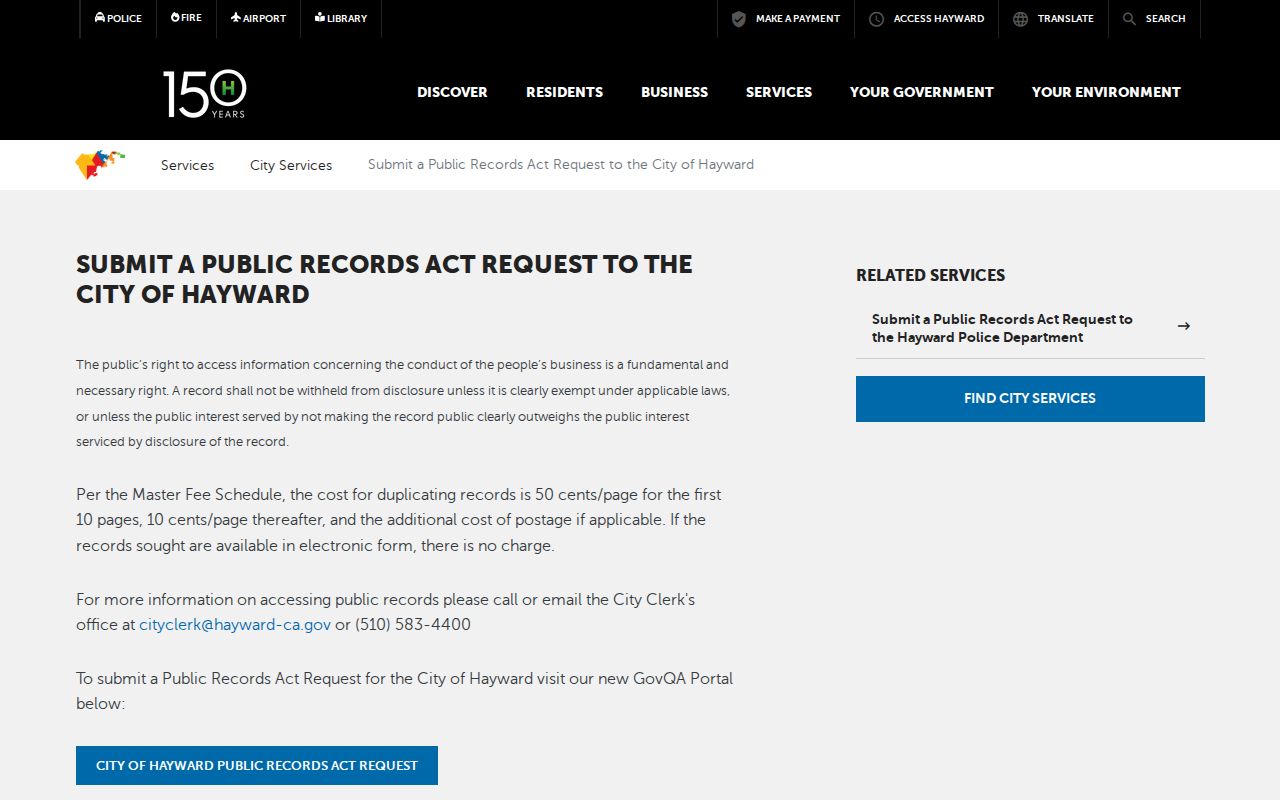
California's CPRA generally gives a Hayward agency ten days to determine whether records are disclosable, with a written extension of up to fourteen additional days in unusual circumstances. A focused request makes that process more useful.
A Deed Notice in a Hayward Resident Trail
Recorded documents are not only a Hayward history source. Alameda's deed-notification program sends an owner the first page of a newly recorded instrument, and the County's FY2024-25 report described a fraudulent transfer affecting an elderly owner. That story gives a practical reason to watch the official record: a new filing can be an early warning that prompts direct contact with the Recorder, Assessor, District Attorney, or police.
Verify the sender before paying for anything. A solicitation may display a real APN or instrument number and still be private marketing. The County's ordinary recorded-copy rate for a Hayward deed is $3.50 per page, so compare a high-price notice with the official Clerk-Recorder channel at (888) 280-7708. Use the deed image, not a mailer, as the source for a title question.
The same distinction separates official Hayward rolls from compiled commercial databases.
| Source type | Strength | What to do next |
|---|---|---|
| Official Hayward custodian record | Known keeper, stated coverage, traceable field or image | Check date, identifier, and access limits |
| Compiled commercial database | May join many public fragments into one lead | Return to the cited County, city, court, or archive record |
That comparison is useful for Hayward genealogy, seller verification, and scam avoidance. It does not turn a compiled entry into a verified Hayward residence.
Hayward Resident Data, Privacy, and Lawful Use
Hayward records access has boundaries that matter as much as the search fields. Safe at Home can provide a substitute mailing address for survivors and other eligible participants. Government Code provisions protect the home and contact data of specified officials and public-safety workers. The federal Driver's Privacy Protection Act closes personal motor-vehicle residence data. California's consumer privacy law gives covered consumers access, correction, deletion, and opt-out rights, while the 2026 DROP system is designed to send one deletion request to registered data brokers.
Use public Hayward records for family history, civic transparency, reconnection, estate research, and personal safety. Keep a source note for every Hayward hit, do not publish a protected address, and ask the custodian how to correct an error. Public availability is not permission to assemble a private dossier or to create unwanted contact.
Lawful personal use. Hayward and Alameda records can support a focused, lawful question, but using names or addresses to stalk, harass, intimidate, or harm anyone is prohibited. Stop when the source does not provide the fact you need and verify through the proper custodian.
That final limit keeps the Hayward residents directory useful. The best Hayward result is a well-sourced lead with a clear record boundary, not a claim that one search can reveal every person connected to an address.